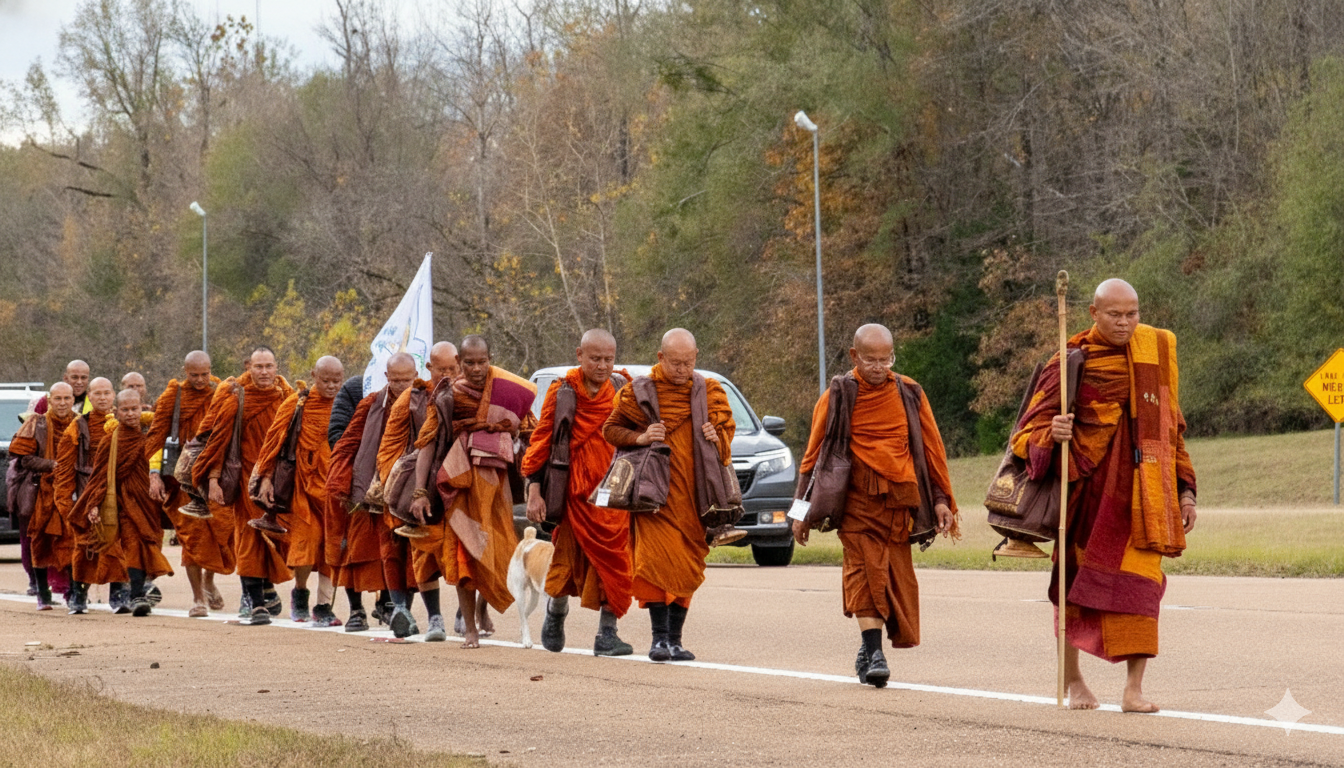
The monks’ banner says “Peace.” Their feet are quietly carrying a much harder teaching.
I was texting yesterday with a friend I met in Sri Lanka. He wrote that on the local news there, they were showing a group of monks walking from Texas to Washington, D.C., carrying signs about peace and mettā, moving step after step along the highway.
I pictured their feet on the pavement and thought of Thich Nhat Hanh’s book title: Peace Is Every Step
The image is striking: saffron robes against the gray interstate. On the surface, they walk for external peace, calling attention to war and suffering. But their method shows something deeper: the inner peace Thich Nhat Hanh points to, where every step, taken with awareness, is peace itself.
Henry David Thoreau wrote,
As you simplify your life, the laws of the universe will be simpler; solitude will not be solitude, poverty will not be poverty, nor weakness weakness.
The monks simplify to the basics: body, breath, footfall.
There is no escape from the roar of trucks or wind. They show that peace isn’t “out there” in Washington; it must live in each contact of foot and earth.
Charlotte Joko Beck called this “slow, gritty work”. She meant staying with reality as it is, instead of waiting for a more spiritual life to appear. Her question was always, “Are you OK?” Not “Is the world OK?” but: can you stay with the raw sensation of this moment without building a big story around it?
For the monks, that reality might be the sting of the wind or a blistered heel. For us, it might be a difficult email or a lonely evening.
the edge of our practice
When we can’t be with that, Joko says, we’ve found the true edge of our practice.
Thich Nhat Hanh makes the same point more softly:
Breathing in, I calm my body. Breathing out, I smile… Dwelling in the present moment, I know this is a wonderful moment”
our appointment with life
If we wait for peace only after conflict is resolved, we miss his teaching: our “appointment with life is in the present moment”. The monks keep that appointment on the shoulder of the road; we can keep it at the kitchen sink.
From the outside, their journey looks vulnerable: no guarantees, relying on strangers for food and shelter. Joko suggests that as we do the gritty work of observing our thoughts and feelings the “residue” in the body breaks down under the gentle light of the observing mind.
the rich texture of being alive
Of course, we don’t need any big public demonstrations, or millions of social media views.
Our “peace work” happens in checkout lines, family arguments, and our restless minds. The monks walk for peace in the outer world, but they quietly demonstrate a more radical truth: that peace must be every step, or it will never truly arrive.
The monks are getting closer to D.C., but their real destination, one could say, was always the ground beneath their feet. Our work is the same: to discover that the place we stand now is exactly where peace has to begin.




Leave a Reply