Author: Tom Davidson-Marx

  • where the quiet joy lives

    where the quiet joy lives

    It’s in the naked ordinariness of our life where the quiet joy lives.

    Life for me right now is good. I returned from two months of intensive practice in Sri Lanka and Malaysia. My health is OK. I even went to the gym yesterday.

    Yet stuff comes up. Not because of anything in particular. I’m sitting here typing this and I sense some uneasiness, some anxiety, perhaps a tropical depression is forming in the warm waters of my psyche.

    I used to feel the need to do something about these kinds of feelings. Or to distract myself with doing the dishes or cleaning up my room. But now after this time in retreat I don’t do anything about them.

    Not purposefully, anyway.

    I just be with them. Sometimes it feels that if I give them an inch they’ll take a mile. Other times I give them a mile and they take an inch.

    There is no script. No overarching narrative. Just stories my mind makes up about what I feel and think.

    The practice does the work, not me.

    I just sit with it all, the mess in my room and the mess in my mind. I do the practice, yes, but the practice does the work, not me.

    I sit, yes, but like a bad soccer player, I surrender the goal.

    My hopes of being special after being away for two months meditating- just thoughts in my head. 

    I think it’s our nature to bloom.

    Elizabeth Callahan describes, in this very short video, what Mahayana Buddhists call Buddha Nature– the priceless gift of our practice- as openness, non-reactivity, and prfound connection with all things.

    We can’t make this happen. We can only put together the conditions for the blooming to happen. For me, right now it’s meditating every day. I just do the practice and try my best to give up any hope for results. As T.S. Eliot observes in his poem “East Coker” (Section III):

    I said to my soul, be still, and wait without hope
    For hope would be hope for the wrong thing; wait without love,
    For love would be love of the wrong thing; there is yet faith
    But the faith and the love and the hope are all in the waiting.
    Wait without thought, for you are not ready for thought:
    So the darkness shall be the light, and the stillness the dancing
    .

    If we let hope motivate our practice, it is likely to be “hope for the wrong thing”—meaning, hope an ego-centric reward, or the comforting illusion of some kind of certainly.

    I just sit in uncertainty and let go of trying to somehow make my awareness of my breath a spiritual experience.

    What emerges is a trusting of simply what is- awareness like open space, vivid colors, a cup of tea, putting clothes in the dryer, typing this message.

    It’s in the naked ordinariness of our life where the quiet joy lives.


  • walking each other home

    walking each other home

    In meditation, we patiently cultivate two qualities of the heart that are so comforting and life-changing, some call them “refuges.”

    Now, while loving-kindness and compassion might sound like these grand ideas, they’re actually really practical meditation practices. When you put in the effort, they truly transform your heart.

    Think of it as a master gardener bringing dead soil back to life. 

    These practices can do the same for parts of yourself you’ve neglected.

    In a garden, you set up all the right conditions for things to grow – rich soil, enough sun, regular weeding. All these things work together. But you don’t make a sweet potato grow. 

    When the conditions are right, it just grows on its own. We do the same thing with our hearts: we create the right inner conditions for good qualities to bloom.

    And yep, we’re talking about loving-kindness and compassion.

    These qualities are already in us, though maybe a bit hidden by past choices that weren’t so skillful. Our practice helps us see where suffering is popping up everywhere.

    Here’s the cool part: when you gently tend your heart like a garden, pulling out the ‘weeds’ of fear, disappointment, and confusion, a deep tenderness starts to show up.

    Loving-kindness meditation isn’t about being sappy or pretending to like everyone.

    As the Buddhist teacher and psychologist Tara Brach says,

    It’s not about turning somebody we don’t like into somebody we do like – or pretending to like everybody.

    This practice gives you more inner space, making you friendlier to yourself and others as you quietly repeat phrases like:

    May all beings be well, happy, and peaceful.

    Compassion practice helps us see when others are struggling, and from that awareness, we genuinely wish for their suffering to end.

    There’s no direct word for ‘meditation’ in the ancient language the Buddha spoke. Instead of just telling monks to meditate, the Buddha always talked about ‘bhavana’ – which means ‘cultivation.’

    And it’s clear the Buddha was saying that spiritual development is not so much about attaining any rarified states of consciousness, but rather it’s more about cultivating what he called “wholesome” states of mind. 

    And yes, we’re talking about loving-kindness and compassion.

    Since these qualities are already inside us, practicing loving-kindness is like tilling the soil before planting seeds. It breaks up hard spots and brings up richer, deeper parts of yourself.

    When everything’s just right, things flourish. 

    But does a garden stop growing when the sun sets? Nope, the night cycle is actually crucial. 

    Our inner garden keeps growing even in dark times such as these.

    When we let our hearts feel vulnerable during really tough periods, a new kind of sensitivity grows. We become so tender. Unhappiness can actually be a great tenderizer for the heart. 

    Our practice is to stay with this “quivering of the heart,” as it’s called.

    And in that genuine sadness, there’s a deep love. As we move through layers of fear and denial, we start to see that at the core of heartbreak is love. 

    Our whole practice can be about learning to uncover and rest in this kind of love.

    As we get comfortable with our own vulnerable hearts, we naturally connect with others whose hearts are breaking or who are feeling loss.

    Ultimately, this practice helps us move through life with a light step. And in a beautiful way, it helps us carry others lightly in our hearts. It’s like we’re all walking this path together.

    As Ram Dass often said: “we’re all just walking each other home.”


  • 7 rough spots on the meditative path

    7 rough spots on the meditative path

    A lot of us hit a wall with meditation after that initial exciting phase, even though we know it’s good for us.

    What makes it so hard to stick with a simple meditation we do every day? What gets in our way, and how can we make meditation a regular part of our lives?

    The instructions are so simple: relax and just be aware of what is happening in the present moment. And yet we find this challenging and humbling.

    Even for people who have been meditating for over forty years, like yours truly, daily practice is not always a cakewalk.

    Here are seven common rough spots, and how to move past them

    Even seasoned meditators face these common challenges. They might not hit all at once, but they’re definitely part of the journey.

    1. I’m too busy, I don’t have the time!

    I get this a lot, and I confess I deal with this, too.

    For folks juggling parenthood and jobs, it’s totally valid. But let’s be real: we’re talking about we’re talking about 10 minutes a day here to get started. A lot of us spend way more time than that just scrolling through our phones or browsing online without much purpose.

    2. I can’t get comfortable.

    If you are trying to sit cross-legged on the floor then, yes, it will most definitely get uncomfortable. But don’t worry, you’ve got options! You can try meditating while standing, lying down, or even just sitting upright in a firm chair. Plus, walking meditation is awesome.

    3. My mind won’t stop thinking.

    Ever feel like your brain just won’t quit? Trying to silence your thoughts is like trying to stop the wind – it’s not going to happen. There is even a reference in the Buddhist suttas describing the mind as a “drunken monkey bitten by a scorpion,” always jumping from one thought to the next.

    You say you become hyper aware of all that mental muttering? This is just background noise and is totally normal. Someone estimated that during a 20 minute period of meditation a beginner can experience around 300 thoughts!

    After years of stress and overthinking, our minds crave stimulation, not quiet. It’s not as if you can suddenly turn off your thoughts when you meditate, it just means you are like everyone else.

    4. There’s too much noise.

    Our world is full of sounds. We just don’t have to let them dictate our meditation. Cars going by outside? Fine. Let them go by, just don’t jump in and go for a ride.

    Real quiet isn’t about what’s around you. The more you meditate, the calmer and happier your mind gets, no matter what’s going on outside.

    5. I don’t see the benefit.

    Consistent meditation has a ton of proven benefits, but they take a bit to show up. Some folks feel them quickly, but most of us need to stick with it daily for a few weeks. 

    Just trust the process and keep at it. Think of it like learning an instrument – getting good takes time.

    6. I’m no good at this.

    It’s almost impossible to fail at meditation. Of course, you could intentionally try to balance your checkbook in your head when the bell sounds. But let’s say you put in your best effort. You sit for 20 minutes thinking non-stop meaningless thoughts, that’s fine.

    There’s no right or wrong, and there’s no special technique. Meditation is surprisingly forgiving. You don’t need a clear mind; racing thoughts are normal. There are no strict rules or complicated steps—just find what works and stick with it.

    7. Do I force myself to meditate when I don’t want to?

    Not good. Meditation is not about forcing the mind to be still. It’s more about letting go of resistance to whatever may arise: doubt, worry, uncertainty, feeling inadequate, the endless dramas, fear, and desire.

    Every time your mind drifts into daydreaming, simply and gently, lovingly even, just come back to now, come back to this moment. 

    All you need to do is pay attention and be with what is.

    Nothing else.

    As Frank Clark observes: 

    If you find a path with no obstacles, it probably doesn’t lead anywhere.

    With maturing practice, we can appreciate all obstacles as grist for the mill for deepening insight and freedom.

    Resting in the essential mystery of what is, with no expectations, no overlays, an uncanny wonder and amazement reveal themselves if you are patient.

  • shine on, you crazy diamond

    shine on, you crazy diamond

    Wellbeing, peace and happiness are hidden in plain sight, in the ever-present flow of experience itself, always right here and right now.

    I recently completed an intensive, 30 day silent meditation retreat in California following a very strict Burmese Buddhist lineage, with formal sessions totaling sixteen and a half hours per day.

    Each day began at 4am with the gentle sound of a bell signaling the start of another day of meditation. Each day was another opportunity to delve deep into the intricacies of my own mind.

    When people ask “how was it?” I struggle to come up with an answer that seems to satisfy the person asking. “The water pressure was excellent” feels more genuine than any of the other responses I’ve come up with.

    Flippant, you say? Yeah, maybe, but I’m good with that. Would I do it again? Absolutely!

    This experience allowed me to appreciate not just the act of meditation itself, but also the subtle experiences of life that often go unnoticed. Even the act of drinking tea became a ritual, filled with moments of mindfulness. The aroma rising from the cup, the warmth against my hands, and the taste that lingered on my tongue became sources of joy and reflection.

    As I get older, and meditate more intensively, I’m just blown away how every tiny little piece of what’s happening in this moment right now is an absolute miracle; this tapping of this keyboard and this upcoming sip of tea- ahhh.

    The happiness of well-being

    This line of thought leads to a deeper understanding of why we seek out such retreats. Meditation, at its core, is not merely an escape from our woes, but a way to confront and understand them. Many people join retreats with the hope of achieving clarity on pressing issues, emotional turmoil, or existential questions.

    Yet, what I discovered was that clarity often arises from letting go of the need to control or understand anything. It is about surrendering to the flow of experience.

    Surrendering into the wellbeing of every moment.

    To say my time in retreat was somehow more powerful or more special than this moment right now really misses the mark.

    So why did I go there, if the water pressure in this bathroom here is just as excellent?

    Many of us are attracted to meditation to get over something, like anxiety, or to explore altered states for all sorts of reasons. We all have all manner of issues that at times can seem really heavy and serious, unbearable even.

    But when I take a close look, whatever shows up in awareness is always dissolving and vanishing, constantly shape-shifting like some Marvel character.

    Furthermore, this understanding leads to the realization that the challenges we face are often transient. They come and go, much like waves in the ocean. Each emotion, each thought, is like a wave that rises, crests, and eventually falls away. By observing this process without attachment, we cultivate a sense of spaciousness within ourselves.

    The wellbeing of every moment is dripping with contentment.

    When I try to hold on to something to seemingly deal with it, it feels like I’m trying to pin a tail on a space donkey.

    g3DQWUJ1GvoabI3W3QGkhdRFMfjcqVJOBqn988Ln
    can you pin a tail on this space donkey?

    The historical Buddha appears to never tire of emphasizing that no-things ever actually form long enough to even be impermanent.

    Yet, here we are, often feeling stuck. But stuck in what?

    The experience was also a reminder of the importance of community and shared practice. Each participant in the retreat was on their journey, yet we were all interconnected through our shared silence and intention. The simple act of sitting together in silence created a powerful energy that was both comforting and enlightening. We were each like threads in a larger tapestry, contributing to a collective experience of healing and growth.

    It’s precisely because nothing survives even for an instant, when we really look with focused awareness, that we’re never actually ever stuck. No matter how complicated and difficult our circumstance feels, it’s always just this.

    I love Pink Floyd’s song from their 1975 album “Wish You Were Here” – Shine On You Crazy Diamond. No matter how complex and difficult, it’s always just this crazy diamond of reality as it is right now, shining a light that seems solid and real …

    My time in the retreat grounded me in the present moment. Each second felt like a precious gift, and I learned to appreciate the subtle nuances of existence. It became clear that joy doesn’t always need to be flashy- sometimes, it’s found in the stillness between each thought, in the breath that nourishes our being, in the appreciation of a gentle breeze or the sound of rustling leaves.

    The lessons learned during those long hours of meditation extend far beyond the retreat. They seep into daily life, influencing how I interact with challenges and how I perceive joy.

    The practice encourages a gentle inquiry into the nature of suffering and happiness, inviting us to explore both with compassion. In this exploration, we often find that the answers we seek are already within us, waiting to be uncovered.

    but is actually more like our beautiful Hawaiian rainbows, never staying the same, even if we gaze at it a second later.

    What did I come away with from my long, often tedious hours of silent meditation?

    Well, since you asked, it’s that phenomenal well being, peace and happiness are not the product of meditative huffing and puffing, but are always just right here, shining like a crazy diamond in plain sight, in the ever-present flow of experience experiencing itself, always right here and right now.

    and that a good long, hard meditation retreat was just the thing to re-mind me of this incredibly beautiful state of affairs.

    How wonderful, how marvelous!

    Shine on you crazy diamond, not just in meditation, but in every facet of your life. Let this practice of mindfulness illuminate your path, guiding you toward a deeper understanding of yourself and the world.

  • sit quietly and observe your thoughts

    sit quietly and observe your thoughts

    This simple practice helps release unhelpful preoccupations that creep into your mind space as you sit quietly and observe your thoughts.

    As we release these unhelpful preoccupations, we find less craving for distraction hits like the news. What would it be like to spend more time absorbed in mystery and awe rather than in your to-do list or newsfeed?

    Besides the noble art of getting things done, there is the noble art of leaving things undone. The wisdom of life consists in the elimination of non-essentials.

    Lin Yutang

    With our mindfulness practice we breathe, eat and wash in mystery and awe in every moment. Thomas Merton observed in his 1968 collection of his journals The Other Side of the Mountain how eliminating non-essentials, as Lin Yutang mentions above, is the heart of his monastic vocation:

    I just need to have long periods of no talking and no special thinking, and immediate contact with the sun, the grass, the dirt, the leaves. Undistracted by statements, jokes, opinions, news.

    Thomas Merton

    Sure, obstacles will arise. It really wouldn’t work otherwise. Frank Clark observes:

    If you find a path with no obstacles, it probably doesn’t lead anywhere.

    With maturing practice, we can appreciate all obstacles as “grist for the mill” for this organic process of deepening insight and freedom.

    The Buddha was on point here in the Dhammapada:

    Let go of that which is in front,
    let go of that which has already gone,
    and let go of in-between.
    With a heart that takes hold nowhere
    you arrive at the place beyond all suffering.

    We all experience difficulties, confusion and unhappiness. And even when things are hunky-dory, we sometimes worry if something ominous is just around the bend.

    Yet our practice shows us glimpses of a fundamental OK-ness, a limitless essential freedom that is our birthright. So we go up and down between appreciating life as both a great mystery and a great misery, until the mind eventually settles down.

    observe your thoughts

    Mindfulness teaches us to pay attention and observe your thoughts in a way that doesn’t get sucked into whatever storms may arise in the mind, and let them pass, and rest in the settled mind of knowing you are aware.

    As we familiarize ourselves with this heart of awareness, we see that whatever blocks the heart is mostly self-constructed- and insubstantial.

    The twelfth-century Sufi philosopher El-Ghazali observed:

    If you can lose it in a shipwreck, it isn’t yours.

    As we rest for a moment, simply present, awake and aware, with no agenda at all, we step out of our habitual comfort zones of control, manipulation, into a space of natural open awareness.

    We can’t lose this in any shipwreck.

    I love the line by the Austrian poet Rainer Maria Rilke:

    Ultimately, it is upon your vulnerability that you depend.

    As you sit quietly and observe your thoughts, you open little by little into the warmth and tenderness of our own essential vulnerability, our own heart of awareness, that we all need so much these days.

  • living into what cannot be solved

    living into what cannot be solved

    Mindfulness allows us to live into all that cannot be solved. It’s also a gateway to equanimity, the peace of the present moment.

    The other day, I listened to a podcast of an interview with Frank Osteseki, who is a pioneer in end-of-life care, founding in 1987 the Zen Hospice Project, the first Buddhist hospice in the USA.

    He has trained countless caregivers in how to provide compassionate care for those facing life-threatening illness. There was one line Frank used in that interview that struck me.

    Reflecting on current events, Frank remarked:

    We are developing the capacity to bear witness to that which cannot be solved but can be lived into.

    Frank Ostaseski: Lessons to the Living from the Dying

    I often get anxious and go round in circles in my head, trying to solve or deal with some question or problem.

    Will Bird Flu explode into Pandemic 2.0? Will a certain former USA president be re-elected? (typing this last line, I feel my blood pressure spiking.) 

    But listening to Frank I’m reminded we can hold our seat in the unknown, live into our deepest fears, and get to a good place. Most of what comes at us day after day cannot be solved, but it can be lived into, as Frank put it.

    But just how do I do this? How can I be “equanimous”?

    In Buddhism, there is a lot of teaching on “equanimity.” I struggled for years trying to “be equanimous” with my many life struggles. It took me a long time to realize that equanimity is not some fantastic chilled out mental state I might eventually experience in the future. 

    It’s actually right here, right now.

    The some-day-to-be-attained cooled-out space is actually already here; it’s just this regular, ordinary awareness reading this line right now.

    That’s cazy good news.

    curiosity and openness

    Sure, Frank was talking about training healthcare workers how to care for the dying. But he’s also talking about how to meet our own death, and how we can train ourselves to meet any moment in this unrepeatable life of ours, with curiosity and openness

    Even in the throes of the most distressing morning we can relish what the poet and Zen teacher Norman Fischer describes as the

    great and beautiful secret of meditation practice: you can experience suffering with equanimity.

    Suffering Opens The Real Path

    There is a Zen story that talks about being open and curious I love very much (from the collection: The Book Of Equanimity, Case 20):

    The monk Fayan was going on pilgrimage.
    Master Dizang asked, “Where are you going?”
    Fayan said, “On pilgrimage.”
    Dizang asked, “What sort of thing is pilgrimage?”
    Fayan said: “I don’t know.”
    Dizang said, “Not knowing is most intimate.”
    Fayan suddenly had a great awakening.

    So this 13th century Chinese monk goes on a pilgrimage, and when asked why he was doing this by a master he is visiting, suddenly realizes he doesn’t really know why. The teacher gives him a high five, encouraging him to stay open and curious:

    Not knowing is most intimate.

    This simple quality of not-knowing allows intimacy, goes the teaching. When we fully open to our not-knowing mind, there’s curiosity and openness.

    This intimacy is available right here, right now as your ordinary awareness reading this. The peace of the present moment, this cooled out space, is hiding in plain sight!

    beginner’s mind

    Suzuki Roshi never tired of teaching about what he called beginner’s mind– which is just another way to describe this ordinary awareness of ours:

    If your mind is empty, it is always ready for anything, it is open to everything. In the beginner’s mind there are many possibilities, but in the expert’s mind there are few.

    With the freshness of this not-knowing mind, this beginner’s mind, this always available ordinary awareness of ours, we experience others more intimately.

    listening more deeply.

    To be with another person in this way we are open to listening more deeply, as the poet Rilke teachers us here:

    Were it possible for us to see further than our knowledge reaches, and yet a little way beyond the outworks of our divinings, perhaps we would endure our sadnesses with greater confidence than our joys.

    For they are the moments when something new has entered into us, something unknown; our feelings grow mute in shy perplexity, everything in us withdraws, a stillness comes, and the new, which no one knows, stands in the midst of it and is silent.

    Rainer Maria Rilke, Letters to a Young Poet

    Be well, dear reader.

  • this is why we meditate

    this is why we meditate

    In the present moment we discover a spontaneity beyond time, where there is no aging, no measuring, no comparing to what was, and no worry about what will be.

    Perhaps I get a little carried away with Buddhist contemplation?

    I mean, just the other day I felt compelled to pull over while driving to ponder whether in light of the radical teachings of impermanence, do I continue along as usual, making coffee, going to work and streaming my shows when I get home?

    Perhaps I am ruminating on mortality as I recently had a birthday?

    Aging. It kind of sneaked up on me.

    Am I old? Well, according to John Shoven, a professor at Stanford University, someone age 65 is now considered old. No wonder so many nurses at work ask me when I am retiring.

    I guess I am officially old at 68.

    Woody Allen once remarked about his own mortality:

    I don’t want to live on in the hearts of others. I want to live on in my apartment.

    We know we are going to die. It’s only a question of when. Yet we console ourselves we have lots of time, much of which is spent planning on some better version of now.

    Christopher Titmus recently gave a talk in which he quipped,

    Taking an exam in chemistry is a picnic compared to taking chemotherapy.

    Ulla-Carin Lindquist, at the height of a successful career as a newscaster in Sweden, was diagnosed with ALS. She kept of journal of her few years, published as Rowing Without Oars: A Memoir of Living and Dying, in which she wrote:

    There is no bright future for me, but there is a bright present.

    Reflecting on her line, I suspect life itself let her in on a little secret–that her mortality is not a problem to be solved, but a “brightness” disclosing itself right here, right now, in the present moment.

    Even though I started studying Buddhism when I was 22, the depth of the teachings is really hitting me much deeper now. I appreciate aging as at the heart of the Buddha’s message.

    Suzuki Roshi, whose talks in the 1960s became the classic book Zen Mind, Beginners Mind, taught that each breath was like a whole life, with a beginning, a middle and an end.

    And that each exhale is a kind of dying.

    In our practice, we especially get to know our out-breath, fading into a “sheet of white paper” as Suzuki Roshi described it. To which his student Mel Weitsman adds,

    When the moment of death comes, our last breath is familiar and comfortable. There is no need to be afraid.

    As we journey through the pages of our human story, our practice encourages us to be softer, more vulnerable, more caring, and loving.

    And to flow with change.

    In the present moment we discover a spontaneity beyond time, where there is no aging, no measuring, no comparing to what was, and no worry about what will be.

    Ulla-Carin Lindquist, suffering from a terminal illness, was spot on:

    There is no bright future… but there is a bright present.

    This is freedom. This is love. This is peace.

    This is why we meditate.

  • meeting your edge

    meeting your edge

    The mind throws up resistance to the process of liberation- but we can metabolize this, allowing deep change and a graceful opening into a timeless presence.

    The American Buddhist nun Pema Chödrön tells a story about meeting your edge- of a group of people climbing up a very steep mountain. Some made it to the top, and some, gripped by fear, had to stop halway up.

    She observes:

    Life is a journey of meeting your edge again and again. That’s where you’re challenged and ask yourself questions like, “Now, why am I so scared? What is it I don’t want to see? Why can’t I go any further than this?”

    Meeting your edge can happen in different places. The people who got to the top were not special, maybe they were just not afraid of heights. The ones gripped by fear met their edge sooner and got their lessons earlier.

    Everybody meets their own edge on this path. The late Tibetan teacher Chögyam Trungpa taught that the essence of a mature and transformative practice is to “meeting your edge and softening.

    Our meditation practice asks the same question a seasoned therapist would ask:

    What am I avoiding? What am I afraid of?

    The mind can throw up very interesting resistance to the process of liberation and purification. This resistance has to be metabolized before deep change can occur.

    This is precisely what our mindfulness meditation does.

    Then meeting your edge can be a graceful opening into a timeless presence.

    Last year a sangha member gave me a very inspiring book by Mary O’Malley, the title of which I love: What Is In The Way Is The Way. In her bio on the back cover Mary writes that she “barely survived childhood.”

    Her bio chronicles her “descent into darkness.” After several suicide attempts, she had a “life-changing realization in which she saw through the games of the struggling mind and experienced a full connection with life which is the foundation of her work.”

    There is one line which truly spoke to me, perfectly describing this kind of graceful opening:

    When we dissolve our cloud banks of struggle through mindfulness and heartfulness, we can see, hear, taste, touch and smell the exquisite sacredness of all of life.

    How does this look in practice?

    We’re going along and everything is fine, but then we reach an edge of what we feel comfortable with. It might be a fear of physical pain or unpleasant emotions.

    It can be a fear of change and insecurity; or it may be fear of the unknown.

    Our meditation gently takes us to our edge and invites us to open and soften.

    We don’t just do this once; we do this many times a day, metabolizing our resistance to what is bit by bit.

    In the ancient Buddhist texts, the Buddha would often talk to people suffering from a grave illness. The descriptions they use for their symptoms are sometimes very graphic.

    The Buddha then would ask them something like:

    Even though your body is experiencing all these painful feelings, can your mind be at peace?

    This is a possibility for us, but it takes training and time.

    As mindfulness metabolizes our fear and resistance, we see unhappiness as optional, a habit we no longer need–the emotional analog of an appendix.

    This frees us to love the life that is right here and right now. Sure, it takes training and time- but, oh, what a bargain!

  • Compassion in Buddhism: Why does Kuan Yin have so many hands? 

    Compassion in Buddhism: Why does Kuan Yin have so many hands? 

    Kuan Yin is an archetype of compassion in Buddhism. Sometimes portrayed as female, or male, or androgynously, they manifest the impulse to help suffering beings.

    In his celebrated Four Quartets, T. S. Eliot observed:

    Human kind cannot bear very much reality.

    Reality is a lot to take sometimes. One teacher says this practice builds our “reality tolerance.”

    Ours is a sobering practice

    The bare bones of it is to appreciate the “three inconvenient truths”, as the American nun Pema Chodron calls the “three marks of existence” the Buddha taught are intrinsic to reality: impermanence, stress, and interconnectedness.

    It’s inconvenient for us that everything changes.

    For example, just when I’m feeling settled as I sit to meditate, there’s this pain, or that song going through my head and ricocheting off my inner cranium walls, telling me I have been overdoing it with Spotify.

    Deep down we much prefer convenience

    From a Buddhist perspective, the habit energies called delusion come along to satisfy our preference for convenience, controlling the internal narrative, spinning reality in a distorted way, supporting our insupportable preferences for stability and constancy.

    Mostly, we fall for this over and over, until we grasp that our practice is about seeing these delusive habit energies arise in the mind in their many guises and to work through them.

    A milestone in practce …

    is seeing how our conditioned patterns distort our perceptions of reality in real time.

    This practice is sobering because we get intimate with our personal experience of stress and frustration- one of the three aspects of reality the Buddha called dukkha.

    If we don’t clearly see the mechanisms of our own stress and frustration, it’s hard to be happy. 

    When we see this clearly, there is such a relief.

    In the Pali language of early Buddhism, the meditation we practice is called vipassana. “Passana” means to see, and the prefix vi means “in a particular way.”

    As we adapt to regular sitting practice, there’s a deepening sense of calm and inner composure, which helps us see things more clearly.

    A calmer mind is less inclined to fall for the delusive habit energies of desire, aversion or agitation. We can see our stuff more clearly, our hidden motivation and agendas, for example.

    Tranquility allows a healing to happen, a gathering together of all our broken parts, the unfinished business, the parts we have disowned.

    But the practice doesn’t end here, it’s just getting started.

    Kuan Yin: archetype of compassion in Buddhism
    Kuan Yin: archetype of compassion in Buddhism

    We notice that just as we have work to do, so does everyone else.

    We realize we’re all in this mess together. Even when we do not know what to do next, we feel we should at least try to be kind.

    The late Zen master Bernie Glassman tells us “I define realization as the depth to which one sees the interconnectedness of life.”

    Then he adds a corollary, which emphasizes compassion in Buddhism:

    And the degree of your enlightenment can be measured by your actions.

    Here is a Zen koan- a kind of teaching story- from ancient Zen lore about compassion in Buddhism as the the fruit of our sobering practice, of living our interconnected-ness.

    How Does Kuan Yin Use Those Many Hands & Eyes

    Yunyan asks the more realized monk Daowu:
    “Why is it that the Bodhisattva Guanyin has so many hands and eyes?”
    Daowu responds, “It is like someone sleeping, in the night, reaching behind her head for her pillow.”
    To these words Yunyan said, “I understand.”
    When asked what precisely was his understanding he answered, “Our bodies are covered with eyes and hands.”
    Daowu replied, “Almost. You’re eight tenths of the way.”
    Then, when asked what is the more complete response, was told,
    “There are only eyes and hands.”

    This conversation between two monks is preserved in the twelfth century anthology of Zen stories called the Blue Cliff Record. Both monks, Yunyan and Daowu, were students of the same teacher and would themselves each become famous teachers.

    They both deeply realized this interconnectedness. Daowu, it seems, had a deeper understanding than the younger monk Yunyan, who asked why the bodhisattva Kwan Yin has so many hands and eyes.

    In my mind, Yunyan was really asking “What’s the deal with this deity we all talk so much about, who has a thousand hands and a thousand eyes? What’s up with that?”

    Kwan Yin is an archetype of compassion in Buddhism.

    Sometimes portrayed as a man, sometimes as a woman, and sometimes androgynously, Kwan Yin manifests the altruistic impulse to reach out and help suffering beings.

    Daowu says this altruistic impulse comes deeply from the heart without a second thought- like someone turning in her sleep and reaching a hand behind her head to adjust her pillow. 

    He says this natural impulse of compassion in Buddhism is like having eyes and hands all over our body. True, true, says his companion Yunyan. But he adds- that’s only 80% of the answer. 

    The full answer, he says, is realizing “There are only eyes and hands.” I appreciate the writer James Ishmael Ford take on the full answer here:

    Just this. Ends and means, one thing; our interdependence and you and I, one thing.

  • a gentle rain in the garden of the heart

    a gentle rain in the garden of the heart

    I was initially turned off by Buddhist metta meditation. I felt it was silly. But slowly, things changed. Now I hold this practice most dearly.

    I was initially turned off by metta, or loving-kindness, meditation. I felt it was silly sentimentality, putting on a Pollyanna-ish fake smile.

    But slowly, things changed. Now I hold this practice most dearly.

    It turns out loving-kindness meditation is not sentimentality, and it is not really affection. It’s more about living with the Buddha called con-contention in your heart, as he describes here:

    The world may quarrel with me, but I have no quarrel with the world.

    Linked Discourses 22.94

    The teacher Shaila Catherine offers us this description of metta meditation:

    We cultivate loving-kindness as an invitation to soften our hearts, to connect deeper with all of life, and abide in an un-conflicted relationship to all things.

    Buddhist metta meditation is like a gentle rain in the garden of the heart.
    Buddhist metta meditation: a gentle rain in the garden of the heart.

    One way to do this practice:

    First, we choose either ourselves or one person for whom we feel a safe and genuine connection, perhaps a mentor or trusted elder.

    The practice is to combine in awareness the felt sense or image you have of yourself or the other with the calm, even repetition of the four phrases.

    The Four Traditional Metta Phrases

    May I/ you/ they/ all beings…

    Be safe and protected (from inner and outer harm)

    Be happy

    Be healthy

    Live with ease of well-being

    The repetition of the phrases is not meant to elicit any kind of feeling- they are not incentives to push for some feeling or other.

    The phrases are simply expressions of the intention of kindness and friendliness, full stop.

    The Buddhist psychologist and teacher Tara Brach says:

    It’s not about turning somebody we don’t like into somebody we do like – or pretending to like everybody.

    The phrases are vessels or carriers to express these gentle intentions of the heart.

    You offer the phrase to the person; you stay with that awareness of blending the sense or image of the person with the phrase, then you let it all go- until the next phrase arises.

    It’s a really simple practice

    Just like all the other practices in our tradition- the profundity sneaks up on you later, trust me. Don’t let the simplicity deceive you.

    And just like with the breath, just as you don’t keep checking if you are feeling the breath yet … likewise you don’t keep checking am I feeling metta yet?

    We just offer the phrase and let it go … until the next phrase arises.

    One of my teachers, Sharon Salzberg, says:

    Let your mind rest in the phrases. You can be aware of the phrases either with the breath or just in themselves—the focus of the attention is the phrases. Feelings will come and go; his practice is not about trying to make feelings happen.

    Metta is a practice of directed intentionality. We are intentionally inclining the heart toward gentleness and friendliness.

    Here is an description of this “directed intentionality” and what it means in practice, by Jack Kornfield- it’s a six minute video:

    Seeing the Goodness, a short talk on metta by Jack Kornfield

    It’s truly amazing we can cultivate this intentionality, like a gentle rain in the garden of the heart, nourishing everything that grows in it.

    Interested in learning more about this wonderful practice?

    Sharon Salzberg offers crystal clear guidance on this timeless path in these two books: Lovingkindness: The Revolutionary Art of Happiness, and her latest Real Love: The Art of Mindful Connection. The Malaysian monk Bhante Sujiva has dedicated his life to these teachings; his clear book on the practice of metta can be a helpful companion in developing this practice.

    “In gladness and in safety, may you be at ease.”

  • Buddhist insight in our day to day life

    Buddhist insight in our day to day life

    We can experience deep Buddhist insight by examining our present moment experience of seeing, hearing, smelling, tasting, touching, and thinking.

    This mind of our is pretty amazing. Our cognitive power propels us to the top of the food chain on this planet, and maybe even on others as we plan the colonization of Mars.

    But the mind can also make us feel miserable, stressed and confused.

    Our cat Piko doesn’t seem concerned at all about what might happen tomorrow. He appears oblivious to metaphysical or philosophical concerns or anxieties.

    He’s definitely got a leg up on me here.

    Whenever Piko feels an emotion, it seems to arise and fade naturally, like a cloud passing in the sky. He might carry a grudge briefly; but I doubt he feels guilt or blame the way we do.

    His kin don’t look the type to carry a grudge around for centuries

    Looks like he’s got two legs up on all of us.

    The Buddha taught that everything we need to free ourselves from all emotional or philosophical anxieties is available right here and right now just by noticing how we experience the world.

    We can experience deep Buddhist insight simply by examining our present moment experience of seeing, hearing, smelling, tasting, touching, and thinking.

    We may notice chains of discursive thinking arising out of nowhere, about anything.

    While sitting quietly we may hear a bird and within a second we are worrying we haven’t heard as many birds as we used to in the mornings and become enthralled in a climate change revenge fantasy.

    The meditation teacher Shaila Catherine recounts a student described what she observed in her thoughts and feelings the day she lost a hair clip:

    She knew she had to go buy a new one and felt annoyed that she had to make a special trip to the store that day. Thoughts arose how could she lose it?

    Now she has to spend more money. Her job is not paying well. Thoughts drifted to never having enough money and fear she will never have enough.

    Feelings of failure and self-criticism are amplified. She decides she had better get a new job. But doubt arises: what else can she do for work?

    All this arose from a simple thought about losing a hair clip.

    This may seem like a trivial example. But, heck, I admit my days are peppered with anxieties which are as benign as those brought about by losing a hair clip, and which, if not experienced with some mindfulness, morph into self-recrimination, and anguish.

    Even after forty years of meditation, I catch my mind running around on a mental hamster wheel trying to figure out some vital issue, which, after a mindful pause and some reflection, turns out to be on the same order as losing a hair clip.

    We can experience deep Buddhist insight in our daily life
    We can experience deep Buddhist insight in our daily life

    We can explore the feelings that lie underneath the issues we go on and on about in meditation. We can bring these feelings to therapy sessions and learn about how our past influences our life today.

    Or perhaps the absurdity of what we are going on about gives us a good laugh.

    Simple reminders can help- we can remind ourselves to just pause for a moment. Take a breath. Interrupt the flow of that restless thinking.

    We can employ the Buddhist insight technique of labeling your daily life experiences- recognize that “this is what restlessness feels like” or “this is worry.” If we put the time into practice, we move our baseline capacity for this kind of self-reflection.

    Our lives become more livable. Love visits more often. And we are here for it all with care and compassion.

  • the essence of mindfulness practice

    the essence of mindfulness practice

    What a marvel, what a special thing it is to be conscious, to be aware, and to know that we’re aware- this is the essence of mindfulness practice.

    The other day I read this haiku by the Japanese poet Kobayashi Issa. It stopped my distracted mind in its tracks.

    What a strange thing!
    To be alive
    beneath cherry blossoms.

    What a marvel, what a special thing it is to be conscious, to be aware, and to know that we’re aware. We’re not here for that long, really, and I keep thinking I need to use my time well.

    the essence of mindfulness practice

    But simply being aware is not enough, it’s the knowing of being aware that’s so special. This is the essence of our mindfulness practice.

    When we settle into this twin marvel of being aware and knowing we are aware we also discover another set of twin marvels: profound peace and freedom.

    seetling into being aware

    Settling into being aware doesn’t depend on anything being a certain way. We can settle into being aware of a grumpy mood, a stubbed toe or a fragrant cup of green tea.

    The settling part of settling into being aware suggests our distracted mind is sitting in the back seat, for the moment anyway.

    stepping out of our thought stream

    We see how our sometimes ridiculous, repetitive thought stream continually constructs our view of who we are, who others are in our world- often through unexamined judgments, defenses, ambitions, and the whole nine yards of our conditioned reactivity.

    I particularly love the response the late Indian sage Nisargadatta gave when asked about the distraction of thoughts in meditation:

    The mind creates the abyss, the heart crosses it.

    The thinking mind constructs views of right and wrong, good and bad, self and other. This is the abyss. When we let thoughts come and go without clinging, we make use of them to rest in the heart that Nisargadatta mentions.

    This heart knows the thoughts are only clouds passing through the empty expanse of the sky.

    The settled mind of knowing you are aware is the heart of mindfulness

    We simply pay attention in a way that doesn’t get sucked into whatever storms may arise in the mind, and let them pass, and rest in the settled mind of knowing you are aware.

    As we familiarize ourselves with this heart of awareness, we see that whatever blocks the heart is mostly self-constructed- and insubstantial.

    The twelfth-century Sufi philosopher El-Ghazali observed:

    If you can lose it in a shipwreck, it isn’t yours.

    al-Ghazali

    As we rest for a moment, purely and simply present, awake and aware, with no agenda at all, we radically step out of our habitual comfort zones of control, manipulation, into a space of natural open awareness.

    We can’t lose this in any shipwreck.

    I love the line by the poet Rilke:

    Ultimately, it is upon your vulnerability that you depend.

    the tender heart

    We open little by little into the warmth and tenderness of our own essential vulnerability, our own heart of awareness.

    It’s the birthplace of the renewable resources of courage, love, empathy, and compassion we all need so much these days.

  • a keener love of simplicity

    a keener love of simplicity

    Meditation helps us put down the baggage we carry around. Traveling lightly, we feel airborne. We move into a keener love of simplicity.

    There is a story by Mark Twain about someone who dies and goes to “heaven” and gets a pair of wings and a harp. At first, they used the wings as a way of moving around the new place, and plucked on the strings of the harp trying to get some divine tunes out of it.

    They soon realize, though, that in this place you don’t need wings to go anywhere and simply by desiring to hear divine tunes, celestial musicians (their house band, I suppose) show up and play.

    After dropping the wings and the harp, they found a profound fulfillment in simply being.

    We all just want to be happy and feel at home in our own lives, but, as the song goes, we are looking in all the wrong places.

    We burden ourselves with unnecessary wings or harps thinking that happiness is all about having certain things or acting in a special way. Many of the voices we listen to lead us on a long walk on the hedonic treadmill Buddhists call samsara.

    But one day we have this marvelous insight: we already have what we need.

    This meditation is a radical act of self-discovery. We uncover the treasure of our very own being. We lose interest in listening to the voices shouting at us about our deficiencies.

    One of my teachers Sharon Salzberg says:

    We learn not to get caught in trying to reach after things we never really needed to begin with.

    Along these lines, the poet Rumi asks:

    How long will we fill our pockets
    Like children with dirt and stones?
    Let the world go. Holding it
    We never know ourselves, never are air-born.

    Rumi, translated by Andrew Harvey

    Meditation helps us put down the baggage we carry around so we can be airborne and travel lightly. We move into a keener love of simplicity — of lifestyle, speech, and even how to do the dishes and arrange our sitting space.

    We get less caught up in what others say about us, or imagine they say.

    The grip on our likes and dislikes softens.

    We eventually get how much nicer it is to relax into our natural, free and easy being-ness that is already right here, right now, than it is to struggle with having things be other than they are how they are.

    But if we haven’t tasted this free-and-easy being-ness, it can be a hard sell to the psyche.

    You’ll know the sweet taste of being-ness by accidentally stumbling upon it in your practice.

    You can’t make this happen on purpose.

    You just need to develop a daily meditation habit and put the time in. As the late Indian author and speaker Jiddu Krishnamurti remarked:

    Enlightenment is an accident. Meditation makes you accident prone.

    Then, each moment is fine. Each moment is enough.

    Each moment, no matter how mundane or annoying, is profound and meaningful.

    We practice, as the poet Wendell Berry tells us in this his poem The Wild Geese:

    … not for new earth or heaven, but to be quiet in heart, and in eye, clear. What we need is here.

    Be well, dear reader.

  • you can’t win if you don’t play

    you can’t win if you don’t play

    Experiment infusing your meditation time with playful qualities such as curiosity, lightness, awe, and child-like delight in the present moment’s unfolding.

    The comedy improv teacher Jimmy Carrane mentioned in a blog post that the Illinois State Lottery once had a slogan that went:

    You can’t win if you don’t play.

    Although I’m not endorsing gambling here, we can apply this slogan to how we practice mindfulness. If we approach our practice as a grim duty to sit in formal meditation for so many hours per week, or to always be mindful in our daily life, well, it just doesn’t work.

    mindfulness as play

    But if we view our practice as play, we can experiment infusing our meditation time with playful qualities such as curiosity, lightness, awe, and delight. This can make the journey to enlightenment so much, well, lighter, and more fun. 

    When we actively encourage these beautiful qualities, supporting them as they arise, our practice deepens. Our life finds more dimensions in which to grow.

    Can we infuse our practice with these playful qualities?

    As we engage with all the challenging tasks we face in our day to day lives, can we bring in a little curiosity and lightness?

    We’re not trying to figure anything out; we’re simply being with whatever is happening, inviting awe and a child-like delight in the present moment’s unfolding.

    And keeping the channel open, as Martha Graham once commented:

    There is a vitality, a life force, an energy, a quickening that is translated through you into action… and because there is only one of you in all of time, this expression is unique…You do not even have to believe in yourself or your work.

    You have to keep yourself open … Keep the channel open.

    Martha Graham on the Life-Force of Creativity

    mindfulness as improvisation

    I’m reading this week about improv performers and how they train. What goes into training in the improv arts- in jazz, dance and comedy– aligns so well with our approach to our mindfulness as play.

    We are all improvisers, right? Whatever prefab scripts we apply to our daily challenges don’t always fit well; we are often going off script, improvising.

    And as it is so clear to see in our meditation practice: we don’t know the next thing that’s going to come to our mind, we can’t control our minds, nor should we even try.

    The improv performer and Buddhist meditator Martha Lee Turner sums up the core skills of improvisation:

    Stay in the present moment, listen carefully, do not get tangled up in your ego, keep letting go of your idea from a second ago, and trust what emerges from the group.

    from Half of the Holy Life

    trust the present moment

    This is big for many of us- to trust what emerges. As the actor and stand-up comedian Brian Posehn has this to say:

    Trust in the moment you’re experiencing right now, it will always move you to the next moment.

    Sometimes, Brian says, his improv work allows him to step out of familiar routines and scenarios that “impede freedom” as he puts it. A work which I am guessing helps him discover more opportunities for stepping free of entanglements and than he otherwise would see.

    Perhaps he would agree he is discovering ever-deepening qualities of curiosity, lightness, awe and delight as he keeps the channel open.

    Maybe those who crafted the Illinois State Lottery slogan were sly, secret mindfulness meditators, teaching us from within the belly of the beast- you can’t win if you don’t play.

  • to live wisely, and able to love

    to live wisely, and able to love

    This is our work: to live wisely, not in contention with anything, and able to love.

    What does it mean to practice Dharma in the home stretch of 2023, with all the wars, hate crimes, refugee crises, and environmental catastrophes all over the world?

    I would offer a short and simple response, quoting Sylvia Boorstein, great grandmother, psychologist and Dharma teacher since 1985:

    I want to live my life wisely, not in contention with anything, able to love. This sounds ordinary as I write this, but I think it’s the fundamental goal of spiritual practice.

    On-Being with Krista Tippett

    This week, rather than bore you with my thoughts, I would like to present passages which speak to me directly about just how to live as Sylvia suggests, wisely, not in contention with anything, and able to love.

    As we witness second hand the terrible events in the world, I feel guilty thinking it is also important to celebrate the beauty in my life, and express my gratitude for it.

    The poet Rumi counsels us to “let the beauty we love be what we do.” Even if we are stuck doing what we don’t really love, our mindfulness practice has a magical way of melting the resistance and opening the door to the alchemy Rumi alludes to here:

    Today, like every other day, we wake up empty and frightened. Don’t open the door to the study and begin reading. Take down the dulcimer.

    Let the beauty we love be what we do.
    There are hundreds of ways to kneel and kiss the ground.

    Still Water Center

    In many places people wake up empty and frightened every day because of the non-stop violence in their lives. What might it mean for me to “kneel and kiss the ground”?

    The poet and essayist Mark Nepo shows the work of our mindfulness practice is a kind of kneeling down into the moment, and kissing the ground of our being, is a kind of self-cleansing.

    Moving through my fears doesn’t mean I have to absorb or placate the demands of others. Facing my pain doesn’t mean I have to withdraw from what comes my way. On the contrary, I need to open the ancient door of my own making and let life kiss me on the forehead.

    James Baldwin, the gay African American novelist, writes of how his struggles for legitimacy and authenticity in the 50s and ‘60s led him to hard fought inner grace, where:

    Love takes off the masks that we fear we cannot live without and know we cannot live within. I use the word love here not merely in a personal sense but as a state of being, or a state of grace—not in the infantile American sense of being made happy, but in the tough and universal sense of quest and daring and growth.

    This, then, is our work. To kneel down into the moment, to kiss the ground of our common experience, take off our masks in the process, and discover peace and joy in the shared nature of being as the mind settles down and the heart relaxes.

    To live wisely, and able to love.

  • basic human sanity

    basic human sanity

    We breathe, and open our hearts no matter how difficult it feels, bringing some peace to our minds as we ask what is compassion?

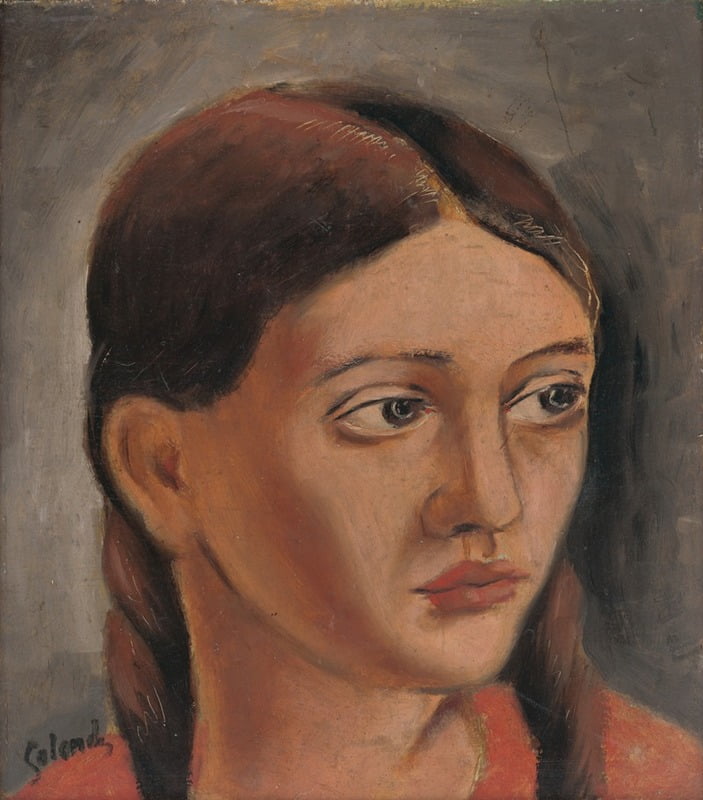
    The ongoing events in Gaza are hard to take in. I am sorry to bring this up, but I can’t shake these feelings. If I could draw a picture of my inner being, it would look like the young woman’s face in Mikuláš Galanda’s work above.

    Yes, mindfulness reveals a certain truth power to just sitting with your emotions, thoughts and feelings as they are, without interfering or trying to change or fix anything.

    Yes, allowing what is there to arise in this way brings peace, even though it may not feel particularly peaceful.

    And yes, I can re-direct myself to settle more easily into the feeling-space those times when I feel my heart turning to stone, out of numbness.

    But what is compassion here? What does it look like?

    It’s still hard to practice with confused and difficult feelings.

    How do we do this?

    For a start, we practice letting thinking be. I can’t stop myself from feeling upset. I have fearful, sometimes angry thoughts, and I can’t do anything to stop them.

    But when we sit with awareness of our body sitting and breathing, we tap into a basic human sanity that is freely available to all of us.

    We create an inner space for all the thoughts and emotions, anger, fear, all of it, to arise- and simply notice the conditioning to interfere, to meddle, to push away, to zone out or to cling.

    As Pema Chrodon observes,

    When you open yourself to the continually changing, impermanent, dynamic nature of your own being and of reality, you increase your capacity to love and care about other people and your capacity to not be afraid.

    Little by little, we learn what it is like to allow everything we think and feel to arise within us without being caught by them or identifying with them.

    This is not another way to deny or escape our feelings, on the contarary.

    When we do this, as the Zen teacher Norman Fischer often says,

    we forgive ourselves for being human. And when we do that, he says, we forgive everyone else for being human, too.

    Suffering Opens The Real Path

    What is compassion

    If we sit long enough, we get in touch with profound human pain and the compassion to meet that pain. Wth practice, over the years, this compassion becomes the center of our lives, little by little.

    We breathe, and open our hearts no matter how difficult it feels, bringing some peace to our minds and compassion deeper into our hearts.

  • what if I don’t feel compassion?

    what if I don’t feel compassion?

    When you don’t feel compassion as you scroll through the daily newsfeed horror show- just be aware of not feeling particularly compassionate.

    I have received emails from readers asking whether we can cultivate a mature mindfulness practice and not feel particularly compassionate, especially regarding the state of the world.

    The horrors reported on media channels we tune into leave me exhausted, someone writes. 

    I can’t seem to brace myself to accept, or even try to understand, much of what is happening,

    writes another.

    One could argue whether compassion is an obligation in the forms of Buddhist practice we find today. My concern, though, is compassion seen as obligation can lead to struggle and the thoughts expressed by the readers noted above.

    Many of us carry some early conditioning around religion, e.g., to enter the Kingdom we must be pious, kind, compassionate, etc.

    And when we come across an Eastern teaching implying compassion is a big deal, we automatically interpret this as something we now have to learn to do, to master.

    But what if compassion is not so much a requirement for a mature practice, but the natural welling-up of warmth towards all beings as a result of a maturing practice? 

    Compassion as a natural welling up differs from compassion as the outcome of effort.

    I admit that amid the horror show of images in my newsfeed , the thought arises at times “Shouldn’t I be feeling more compassionate here?”

    What is I don't feel compassion? Dreamers (ca. 1850-1882) by Albert Joseph Moore; Birmingham Museum and Art Gallery.
    What is I don’t feel compassion? Dreamers (ca. 1850) by Albert Joseph Moore

    But what if I notice that thought as just another in a long line of thoughts based on should vs should not, and realize I’d be better off by not shoulding myself

    Let’s back up and unpack this. 

    1. I was scrolling through a newsfeed and saw pictures of dozens of corpses strewn about a town in Libya devastated last week by a huge typhoon. 
    2. The thought arises “I really should really feel more compassionate than I seem to be feeling right now” (especially after what happened on Maui).
    3. I start thinking I’m not much of a Buddhist meditator, and I’ll never make any progress.

    Our insight meditation comes to the rescue at the third juncture above- where we convince ourselves that if we don’t feel compassion for the pain of others we have no hope of ever progressing on this path.

    Hopefully, our mindfulness kicks in and asks: Can we simply make room for whatever arises?

    This is a point I find myself coming back to again and again, from different angles and approaches, until I get this: this path is all about mindfulness.

    And living and breathing mindfulness is a lifelong practice.

    As our mindfulness practice matures, when thoughts like these arise, we don’t take the bait.

    When we think we should feel a certain way, rather than focus on the “should” and descend into self-judgment, we stay at the level of noting the should and its subtle effects on the organism, e.g., a tightness in the belly, or a subtle fear creeping in. 

    As we do this we catch a break. We step out of our conditioning for a few blessed moments.

    The secret to a mature spiritual practice? 

    Make room for, and be attentive to, whatever arises without getting entangled.

    When we don’t feel particularly compassionate as we scroll through the daily newsfeed horror show- just be aware of not feeling compassionate

    Stay with that awareness and explore its tendrils in the body and mind and notice how it changes and morphs moment by moment.

    There might come a moment when the repulsion fades, just be aware of that. If compassion wells up, be aware of that. And if it doesn’t, it’s not really your concern. 

    The contemporary Burmese teacher U Tejaniya frequently talks about this central issue. Here he is recently speaking to retreatants:

    “There’s almost a mantra in the way I teach,” Sayadaw says.

    We’re not practicing to make things happen in the mind, such as equanimity, or to make things go away, such as fear or uncertainty.

    Rather, we practice observing things as they are happening, and to understand how things are from this close observation.

    Practice As Usual

    Just stay with mindfulness- it’s your refuge. 

  • knee pain nirvana

    knee pain nirvana

    If we get uptight about feeling uncomfortabe in meditation, just remember this simple instruction- give careful and kind attention to whatever arises.

    Do you ever find yourself feeling uncomfortable in meditation after just settling in? If your mind could text you, what would it say?

    Lately, mine would text:

    Oh, no- not my aching knee again.

    just part of the meditation experience

    From the perspective of mindful awareness, an aching knee is simply part of the meditation experience.

    So is dozing off, the tingling sensation of one leg falling asleep, feeling bored or restless.

    When the inevitable discomforts arise, some folks “wait out” that session, gritting their teeth until the bell rings.

    holding still vs settling into stillness

    The next time this happens, rather than waiting out or ending a session, try to see the difference between what Jack Kornfield calls holding still and settling into stillness.

    Holding still is like gripping your seat until the plane lands; there is some underlying fear and aggression going on.

    Settling into stillness, explains Jack, happens when you pour a little compassion on the painful areas. And you relax enough that you are willing to truly feel knee pain, or drowsiness, or boredom, as if from the inside.

    getting comfortable, for now

    If you are new to meditation practice, it takes some trial and error until you find the most comfortable posture. But even when you find that magic meditation set-up, the initial feeling of settling in and feeling comfortable doesn’t last long.

    Soon enough, something itches here, or there’s some new weird throbbing there.

    We are always experiencing these minor aches and pains, but we are not usually aware of them, as we unconsciously go through our day adjusting our posture frequently.

    If we feel dismayed about discomfort while meditating, just remember this simple instruction- give careful and kind attention to whatever arises.

    kindness is essential

    This kindness is essential to our practice, as Cheryl Huber explains:

    It’s not so much what happens as it is how we are with ourselves regardless of what happens –that makes the difference in our lives.

    There is Nothing Wrong With You

    As focus and clarity improve, you notice the crucial difference between physical and emotional discomfort. Once you nail this, there’s no going back to your old ways of avoiding or manipulating your life circumstances.

    The work here is simple: allow physical pains, aches and tensions, to come up on their own, and observe how they reveal themselves in the moment, with kindness.

    The healing of your body and heart is always here, waiting for your kind attention.

    My former teacher Sharon Salzberg has the last word this week. This is how she explains why we practice in this way:

    It’s not the point to suffer; it’s the opening that’s the point. It is that lightheartedness, that bigness, that spacious mind and love that can hold the suffering and accommodate it and integrate it and understand it.

    The Power of Loving-kindness

    As we open more and more to discomforts, they open us in increasingly profound ways.

  • it’s now or never

    it’s now or never

    Mindfulness loosens the “interminable chain of longing” as Robert Frost puts it, so I have half a chance of living this moment now.

    One of my first meditation teachers, Sharon Salzberg, often talks about her early days learning how to meditate in India under her teacher, Munindra. One of his first counsels to her was:

    Try to be with each breath as though it was your first, and as though it was your last.

    Anagarika Munindra

    Being with each breath as if it were the first is a training wheel exercise for being with any moment as if it were for the first time.

    Can we live each conversation we have over breakfast with our housemate as it it were our first?

    Can we search for that super important email as though it were for the first time we misplaced an email- without the uncessary inner friction (e.g. why does this always happen)?

    if I don’t remember this, I get bored or restless

    I notice that when I don’t try to do this I fall into a kind of wistfulness, boredom, or restlessness; mind states Robert Frost perhaps describes in this line from one of his last poems:

    All is an interminable chain of longing.

    The Anxiety of Happiness

    Just being here, being present is enough– I didn’t do a good job at modeling this maxim of mindfulness to our kids as they were growing up. When some cool new event was coming up, like a birthday, or an outing, I would remind tell them from time to time- you know, your friend’s birthday party is coming up.

    As if anticipating a birthday party were more important than whatever it was we were doing at the moment, like getting ready for the day or eating dinner.

    Isn’t this something we all do- sacrifice the present moment for some imagined future one?

    I catch myself wanting, waiting for, or expecting something, anything but this boring present moment- practically all day long.

    It’s like I’m on hold on a call I placed to myself.

    Mindfulness helps loosen the “interminable chainof longing” as Frost puts it, so I have half a chance of living this moment now. And having a more intimate experience with whatever is arising.

    Sayadaw U Tejaniya of Burma reminds us:

    Nothing is ever the same, every moment is always new. Once you can really see this, your mind will always be interested in whatever it observes. No moment will ever bore because your experience shows that “things” are forever changing

    Sayadaw U Tejaniya

    Mindfulness loosens the grip of concepts and opinions have on me about how things should be. I feel more open and soft with how things are if I can remember to invite mindfulness.

    U to Shirasagi by Utamaro Kitagawa (1753-1806); original from Library of Congress
    U to Shirasagi by Utamaro Kitagawa (1753-1806); original from Library of Congress

    That last part of Munindra’s advice to Sharon, to be with each breath as though it were the last, becomes more meaningful the older I get. It brings front and center a complacency that can set in when my practice starts to feel stale.

    It’s amazing how out of touch with reality I can get if I’m not mindful.

    Sharon’s teaching partner of many decades, Joseph Goldstein, observes:

    It’s like we’ve been put under a spell—believing that this or that is going to be the source of our ultimate freedom or happiness. And to wake up from that spell, to be more aligned with what is true, it brings us much greater happiness.

    This is the priceless gift of our mindfulness practice- to be intimate with our moment by moment experience whatever it is– is to wake from this spell of postponement.

    To answer that call you placed to yourself after being on hold so long.

    In the words of the late Krishnamurti:

    Freedom is now or never.

    Choose now.

  • the most important thing

    the most important thing

    This meditation is a self-discovery. We uncover the treasure of our very own being. We lose interest in listening to the voices shouting at us about our deficiencies.

    Someone once asked Suzuki Roshi, the pioneering Zen teacher from Japan who founded the Zen Center of San Francisco in 1969:

    “Roshi, what’s the most important thing?” and he answered:

    To find out what’s the most important thing.

    Byron Katie, who teaches a practice called self-inquiry, said that the world’s number one problem is confusion. As we hang in there with meditation practice, week after week, a little clarity starts to emerge.

    The most important thing that brought us to the meditation cushion may not seem so important as we progress. We may have signed up to get an edge in academia or our social life, maybe to find a group to hang out with.

    After a while, it sinks in: meditation is not self improvement, it’s self-discovery. It’s more about undoing and unlearning conditioned habits rather than getting some special meditation goodies.

    We all just want to be happy and feel at home in our own lives

    And to feel a connection with the world and other beings. 

    But, as the song goes, we are looking in all the wrong places. By habitually looking outside of our skin for fulfillment and happiness, we struggle.

    So many of the voices we listen to- both in our own head and outside, through the media, lead us on a long walk on the hedonic treadmill Buddhists call samsara.

    But one day we have this marvelous insight: We already have what we need.

    This meditation is a self-discovery. We uncover the treasure of our very own being. We lose interest in listening to the voices shouting at us about our deficiencies.

    As one of my teachers Sharon Salzberg says:

    We learn not to get caught in trying to reach out and grasp after things we never really needed to begin with.

    The Healing Is In The Return

    Along these lines, the poet Rumi asks:

    How long will we fill our pockets like children with dirt and stones?
    Let the world go.
    Holding it, we never know ourselves, never are airborne.

    Meditation helps us put down the baggage we carry around so we can be airborne and travel lightly in this world.

    This letting go can be subtle, nuanced. We usually associate letting go as letting go of something. But as the teacher Gil Fronsdal points out, there is a complimentary movement here. 

    With enough practice we appreciate the story doesn’t end with letting go: we discover we are letting go of something but we also are letting go into something else.

    Gil Fronsdal offers this metaphor: a diver lets go of the diving board the seconds later dives into the cool water of the pool, much as we let go of impatience then seconds later relaxing into a feeling of ease.

    If we find ourselves gripped in panic or fear, we learn to let go into the felt safety of relaxation. 

    We eventually get how much nicer it is to relax into our natural, free and easy being-ness than it is to struggle with something.

    But if we haven’t tasted this free-and-easy being-ness, it’s a hard sell to the psyche.

    You’ll know the sweet taste of being-ness by accidentally stumbling upon it in your practice. You can’t make this happen on purpose. You just need to meditate every day and hang in there. 

    Then, each moment is fine. Each moment is enough. Nothing missing or lacking, as the Zen teachers of old would say.

    Every moment is appreciated as profound and meaningful.

  • not a caravan of despair

    not a caravan of despair

    Do you have a fear of missing out on a more spiritual experience doing a mountain of laundry, washing a sinkful of dishes, or raking leaves till kingdom come?

    The meditation teacher Karen Maezen Miller, in a piece published in Lion’s Roar, rightfully calls us on this thought, while describing how the domestic lives of the communal Zen masters of old offered many a critical course correction:

    Rather than think of daily life chores as something to get through; it’s fully experiencing the “getting through” part that frees the mind more profoundly than running off to a cave in the misty mountains.

    In Do Dishes, Rake Leaves, she asks:

    Tell me, while I’m sweeping leaves till kingdom come, is it getting in the way of my life? Is it interfering with my life? Keeping me from my life? 

    Do Dishes, Rake Leaves

    There is a break in this piece while she makes simple observations about folding clothes and washing dishes. Then she answers her own question:

    Only my imaginary life, that life of what-ifs and how-comes: the life I’m dreaming of.

    Then another short narrative digression, ending with:

    At the moment that I’m raking leaves, at the moment I’m doing anything, it is my life; it is all of time, and it is all of me.   

    Pause and ask yourself:

    do you really and truly feel you are missing out on some more spiritual experience by being saddled with a mountain of laundry, a sink overflowing with dishes, or a yard full of leaves to rake?

    I like Josh Korda’s line, that our mindfulness practice is

    not really about being above it all; it’s about being with it all.

    Whether in sitting meditation or raking leaves or doing the laundry, our core practice is to notice what is happening.

    When you feel irritated, bothered, or bored, just be aware of mind states and their underlying feeling tones. Or the feeling tones and their undelying mind states.

    As soon as you notice these feelings, and the awareness in which they arise, you are no longer lost in them.

    As the Korean monk Haemin Sunim writes:

    Awareness is inherently pure, like the open sky. Stress, irritation, and anger can temporarily cloud the sky, but they can never pollute it.

    The wave of irritation, anger, boredom, or whatever it is, naturally recedes on its own as long as you don’t feed it by dwelling or spinning an interesting narrative around it.

    This is not just detachment; we also learn to turn towards and gently open to the sadness or grief that seeks our attention, triggering perhaps sadness, shame or fear.

    I love how Pema Chodron describes this essential skill:

    We join our loss of heart with honesty and kindness. Instead of pulling back from the pain of irritation we move closer. We lean into the wave. We swim into the wave.

    Mindful poetry

    Mindfulness is this simple: we pay attention to what’s happening in the moment, let go of any stories we may tell ourselves about our experiences, and “swim into the wave.”

    As Jiddu Krishnamurti put it:

    Pure attention without judgment is not only the highest form of human intelligence but also the highest expression of love.

    As you get better at it, you realize that challenging mental states are just the resistance to what is. And they rise and recede within the silent space of your awareness.

    When you sit down to meditate today, feel any resistance which may come up — to aches, pains, or mental states such as boredom, restlessness, or doubt.

    Savor the resistance, like a fine wine or a smooth boba tea.

    As it dissipates, feel the joy of the quieting mind, which is always there.

    Ours is a practice of uncovering joy and fulfillment in our lives just as they are, regardless of our circumstances.

    Rumi has the last word this week; on his tomb is purportedly written:

    Come, come, whoever you are. Wanderer, worshiper, lover of life. Though you have broken your vow a hundred times, ours is not a caravan of despair.

    Poems of Rumi

    read another?

    [wp_show_posts id=”22288″]

  • don’t let the mind become a lonely hunter

    don’t let the mind become a lonely hunter

    You have all you need. The bounty is already laid out at your doorstep.

    The title here steals from Carson McCuller’s remarkable debut novel The Heart is a Lonely Hunter, published in 1940 when she was only 23.

    Our mind can easily turn into a lonely hunter when it thinks there is something to get or achieve in meditation.

    When we eat breakfast, can we just eat? Just taste the oatmeal or the cereal or the fruit?

    Can we relish the wisdom of our senses as they taste and smell toast and jam, and not give way to the push and pull of the mind?

    Yes, we have thoughts, we are not trying to become mindful robots.

    But can we be there for the forming of language? And equally there for the arising of thoughts of liking and disliking, catastrophizing and fantasizing?

    Let’s see.

    • 1. As you are making breakfast, you hear a ping sound and as you check out a notification on your phone you …
    • 2. notice the toast is burning.
    • 3. The thought arises: my morning is ruined.

    Can we simply hang there a second in the space that sees the thought “my morning is ruined?”

    As the late Thai meditation master Ajahn Chah remarked, if the house is flooded, can we just have a flooded house, and not also a flooded mind?

    Can we for just a brief second notice what the mind is up to? Can we name it?

    The Zen teacher and poet Norman Fischer observes, “naming a soup salty or spicy or vegetarian is different from experiencing it on the tongue, on the lips, drawing it from the spoon.”

    Our mindfulness practice exposes the conditioned guts of our own mind.

    Vanity Sounds the Horn and Ignorance Unleashes the Hounds Overconfidence, Rashness and Desire (from The Hunt of the Frail Stag)

    Vanity Sounds the Horn and Ignorance Unleashes the Hounds Overconfidence, Rashness and Desire (from The Hunt of the Frail Stag), 1525

    But there is nothing you need to go hunting for, it will all show up with just a little patience with the simple instructions of our mindfulness practice.

    All that is necessary is for us to show up

    … on our cushion, or in the moment as we notice what the mind is up to while paying a parking ticket or shopping for groceries.

    And as we show up again and again, our practice matures; we can see more of this conditioning arise and pass away. We let go more easily and naturally.

    We just show up to dance with our sense impressions.

    And what an exhilarating, mournfully jubilant and spontaneous dance!

    The dance of our life!

    Ajahn Chah described this practice as committing to “taking the one seat.”

    As his student Jack Kornfield describes it:

    Just go into the room and put one chair in the center. Take the seat in the center of the room, open the doors and the windows, and see who comes to visit. You will witness all kinds of scenes and actors, all kinds of temptations and stories, everything imaginable. Your only job is to stay in your seat. You will see it all arise and pass, and out of this, wisdom and understanding will come.

    It’s just this simple. Don’t make it complicated. And don’t let your mind talk itself into becomg a lonely hunter.

    You have all you need.

    The bounty is already laid out at your doorstep.

  • be happy, meditate

    be happy, meditate

    Rather than striving to get rid of stress and confusion, see how these mental states act as a false barrier to our own natural calm, focus, and joy.

    Mindfulness meditation is not just another way to fix what we feel might be broken in our lives. Maybe you struggle with low moods, motivation, or existential malaise. Maybe you feel lonely, or bored.

    Do you sometimes feel like Peggy Lee when she sings “Is that all there is?”

    Meditation, rather, is a way of discovering that whatever you may be feeling or experiencing does not define you.

    As you get better at observing your inner world in the present moment, you see this world is just made up of so many mental images, self-talk, and waves of feeling tones in your body.

    Our practice is about observing how these groups of experiences interact; e.g., how mental images interact with self-talk producing waves of feeling.

    And these interactions often happen will-nilly in our minds.

    As you separate the sensory pieces and greet each one with kindness they simply flow through. And this flow feels good.

    But more importantly, you begin to realize that what you really are is unbounded joy and peace. Bad news happens, as it will from time to time, but it doesn’t define you, as …

    Your sense of well-being is still there.

    Rather than striving to get rid of stress and confusion, we recognize how mental states act as a false barrier to our own natural calm, focus, and joy.

    What a relief!

    We learn how to simply relax back into the peace and joy that was always there.

    If you meditate to get something, some feeling or some imagined mental state, it becomes another goal, one which may lead you to judge yourself as failing or succeeding.

    This reinforces what classical Buddhism calls “grasping and aversion” — and often leads to a scattered, anxious mind.

    With time and practice, you discover an open awareness which is inherently free, peaceful and joyous. And you recognize this as a more profound and delightful “you.”

    You start to appreciate the difference between pleasure and happiness.

    Many of us live from pleasure to pleasure, with some waiting around in between.

    But the happiness you discover with meditation practice comes from deeply experiencing your core, who and what you truly are. It’s more fulfilling than sense pleasures, which seem pedestrian in comparison.

    There is no waiting around here; it’s on tap 24/7, with all the bandwidth you need.

    One of my favorite meditation teachers, Cheri Huber, reminds us that:

    It’s not so much what happens as it is how we are with ourselves regardless of what happens –that makes the difference in our lives.

    But let’s be clear: sadness, jealousy, anger, fear, physical and emotional pain, all of it, will still arise.

    But these are simply surface perturbations.

    We’re talking about a radically profound change in the relationship with these experiences. Meditation is a tool to see right through them, to this inner core of unperturbed peace and happiness.

    How cool is this?

    Be happy, meditate!

    read another?

    [wp_show_posts id=”22288″]

  • chocolate comes, chocolate goes

    chocolate comes, chocolate goes

    Impermanence is the fragrance of my life just as it is. This notion brings a subtle joy to these old bones and bare scalp.

    A New Yorker magazine cartoon depicts a couple strolling down the street, one saying to the other:

    These are the ‘good old days’ that someday we won’t be able to remember.

    I think a lot about when the kids were little, and how great it felt to be a new dad, and now that both kids are adults, and living in an empty nest… Well, I feel sad sometimes.

    Like the cartoon, I know there are so many memories that aren’t easily accessible anymore. That “someday we won’t be able to remember” is here. I guess memory itself is impermanent, uncertain, imperfect, fading.

    At least mine feels this way.

    One of the Buddha’s most significant teachings is to really examine our life and our world as impermanent and changing all the time, disappearing even as it arises.

    There is a chant in the Pali language I used to chant daily as a young monk in a monastery in Sri Lanka (before kids):

    Anicca vata sankhara/ Upada vaya dhammino/ Upakituva nirujihanti/ Tesang vupasamo sukho

    One translation would be:

    All conditioned things are impermanent/ Their nature is to arise and pass away/ To live in harmony with this truth/ Brings the highest happiness.

    How do we live in harmony with the way things actually are when I can’t even remember what I had for breakfast yesterday?

    But I can appreciate the point here. The chant suggests our discontent comes from wanting things to differ from how they are. Like trying to push a river in a different direction with our bare hands.

    Take my hair, for example (yes, please take my hair!) As many of us get older, the hair thing comes up (or off in my case).

    what happened to my hair?

    When I look in the mirror, it’s like I am seeing a photoshopped version of myself. What happened to my hair? Sure, there’s not much left, but I catch myself quarreling with nature herself that what little she left me with is all white.

    Our son came home for the summer yesterday after finishing his 2nd year in college. It is truly magnificent to see him again. And I really can’t wait for him, as my dedicated hair trimmer, to cut off this sparse outgrowth of white partially covering my scalp.

    how to live in light of impermanence?

    The question I turn over a lot in my mind is how do I live as I let the Buddha’s teaching on impermanence soak into my rickety bones?

    That Pali chants suggest the answer rather obliquely: To live in harmony with the reality of impermanence brings great happiness.

    How do I live with what little time I have left that feels in consonance with the way things are?

    Shortly before he died, William Butler Yeats wrote:

    If I had to put it in a single phrase, I would say that one can live the truth, but one can really not know the truth, and I must express the truth with the rest of my life

    This helps immensely. It takes the burden off trying to get a deeper insight into impermanence through my practice of insight meditation.

    I got it enough already. I just need to be mindful of not wasting time, and expressing the truth of impermanence with the time I have left.

    I love how the Austrian poet and novelist Rainer Maria Rilke expresses this:

    The knowledge of impermanence
    that haunts our days
    is their very fragrance.

    The fragrance of impermanence IS the fragrance of my life just as it is. This brings a subtle joy to these old bones and bare scalp.

    And the fragrance of impermanence is sweet.

    I think the late, great Tibetan Lama Yeshe should have the last word here:

    Chocolate comes
    Chocolate goes
    Chocolate disappears
    All such transient pleasures are like this.
    But take heart!
    There is another kind of happiness available to you,
    a deep abiding joy that comes from your own mind.
    This kind of happiness is always with you, always available.
    Whenever you need it, it is always here.

    This is why I keep meditating. This joy just gets deeper and more meaningful every day.

  • Buddhist death meditation: letting go of regrets

    Buddhist death meditation: letting go of regrets

    Buddhist death meditation encourages a gradual letting go of regrets.

    In her most recent book, Alive Until You’re Dead: Notes on the Home Stretch, the 81-year-old Zen teacher, editor and writer Susan Moon relates an ordeal she went through while riding on public transit from Berkeley to the San Francisco airport.

    When she got to the airport, she realized that her carry-on bag, which had her IDs, credit cards, cash, appointment book and teaching notes, had been stolen.

    She writes she felt “stripped of everything.”

    She could not board her flight to her teaching gig without her ID, but she still had her round-trip public transit ticket. So she took the train back to Berkeley. And on the way home, she had an epiphanic insight.

    Yes, she lost some valuable stuff, but she suddenly realized she still had her life, her body, her family, and her friends.

    “I touched my own knees in amazement, and wanted to jump up and down in the train, shouting, `I’m alive! I’m alive!’ She writes:

    The theft was a strange gift. I lost some objects, yes, and I gained a sense of gratitude for my life that is still with me. I often forget how amazing it is to be alive, but if I concentrate, I can open a drawer in my mind and find the memory of that train ride.

    My life feels more complicated each day, with a ridiculous number of choices to make and noise to filter out. I get stuck in overwhelm mode. My system gets bogged down, flooded with sticky memories triggered by the media.

    As much as I try to practice culture war pacifism, the news still gets to me. But then I reflect on the words of the American Buddhist monk, Ajahn Nisabho:

    There is a role for political discussion, for talking to people about what is meaningful. But it’s very important to understand that as practitioners of this path, you have stepped into a higher order narrative and received something which is far more important than the political debate of the day.

    Reading this, I take a breath and try to connect with this “higher order narrative.”

    I appreciate the late Indian philosopher Krishnamurti’s words here:

    You think you’re thinking your thoughts. You are not. You are thinking the culture’s thoughts.

    Yeah, and many of us even take our cell phones to bed with us. I admit to being guilty as charged (or maybe guilty when charged–my phone, that is.)

    what is this higher order narrative?

    The other day I sat in meditation, turning Ajahn Nisabho’s phrase over in my head: what is this higher order narrative I have stepped into? And as nature would have it, I had my own epiphanic insight.

    I’m not sure I can describe it in my own words, but a few lines from the poem “When Death Comes,” by Mary Oliver kept coming up.

    When it’s over, I want to say: all my life I was a bride married to amazement. I was the bridegroom, taking the world into my arms.

    perfect just as it is right now

    Our simple mindfulness shows us this amazing, crazy world is perfect, just as it is right now. It couldn’t be otherwise.

    Yes, even my life as it is right now: overweight, under-exercised, and not looking forward to the long drive home in heavy morning traffic from my night shift job.

    I used to feel quite depressed. A part of me was consumed with fantasies and expectations: my kids, my marriage, my meditation practice, my crazy job.

    I’m much happier now.

    letting go of these fantasies of some other life

    Finding happiness was about letting go of these fantasies and realizing that life is truly amazing without them. I would even say–especially without them.

    My higher order narrative is just this: when I lie on my deathbed, can I let go of any regrets for having just been me?

    Thank you Suan Moon, for the gift of having your bag stolen on public transit, and for sharing it with us.

  • no zombies here

    no zombies here

    One of the most frequent misunderstandings I hear about meditation practice is it will turn us into “non-judging” zombies.

    It’s easy to see why one would think this, since mindfulness teaches us to pay attention to our direct experience non-judgmentally, well, then it would seem to follow that we will eventually lose the capacity or willingness to judge.

    Mindfulness is actually about slowing down the often rapid-fire judging most of us are doing non-stop – so that we become more familiar with what’s really happening at any moment before we make hasty, often inaccurate decisions, many of which we later regret.

    mindfulness allows clear seeing

    Mindfulness allows us to suspend judgment briefly, long enough to see a situation more clearly; it doesn’t erase our mind’s ability to judge and make clear distinctions.

    Buddhist teachings make an important distinction between the “judging mind” and the “discerning mind.” The judging mind tends somewhat compulsive whereas the discerning mind is more relaxed and open, and more capable of a reasoned response.

    The judging mind is often clogged up with opinions, some unacknowledged, and the inner reactions to these opinions, frequently below the surface of conscious awareness.

    This judging mind often operates at a primal level psychologists call “primary process thinking” – what Buddhist meditation allows us to see as “liking and disliking” arising in response to objects of attention.

    the discerning mind

    In contrast, the discerning mind is quieter and calmer, which sees what is happening and makes clear choices, such as “let’s not go down this road” in the presence of angry thoughts and the welling up of a revenge fantasy in the mind, for example.

    This calmer, more quiet discerning mind can be very straightforward and honest. It doesn’t act like the know-it-all judging mind- which is often hiding a sense of insecurity.

    Mindfulness allows us to have our own unique tastes and preferences, to celebrate them, without one-upping or putting down others who may not feel the same way we do.

    seeing through automated processes

    Charles T. Tart, Ph.D., known for his psychological work on the nature of consciousness, and as one of the founders of the field of transpersonal psychology, has a line I love:

    Automatized processes suck!

    And the judging mind is often the the leader of the pack of automatized processes.

    Let’s have Dr. Tart elaborate:

    Somebody looks at you funny from across a room, for example, which triggers automatized perceptions and reactions, that “People don’t love me!”

    In the first fraction of a second, this is a relatively low intensity reaction, but it can suck up more and more of consciousness, and within two or three seconds you are feeling really bad about nobody loving you, and your perceptions are now further biased so that you’re more likely to notice anybody looking at you with an unpleasant expression on their face, further strengthening the process of feeling rejected.

    A funny look from somebody lasting half a second might make you feel miserable the rest of the day.

    Mindfulness allows us to see these “automatized perceptions and reactions” and slowly, with practice, let them dissolve.

    I will leave you this week with a line from Carl Jung:

    Until you make the unconscious conscious, it will direct your life and you will call it fate.

    Our marvelous mindfulness meditation practice does just this – and so much more.

  • the courage to grieve, and to sing

    the courage to grieve, and to sing

    We realize everyone is experiencing the same impermanence that we are. This is one Buddhist insight I hang on to. It feels comforting.

    These are not my words. They were written by Kathryn Schulz, a staff writer at The New Yorker and the author of the deeply moving Lost & Found: Reflections on Grief, Gratitude, and Happiness, which explores grieving her father’s death.

    Reading just a few pages of her book moved me the way Hawai’i’s own Iam Thongi did as I watched his make-or-break audition for American Idol three months ago.

    It was good enough to advance him into the competition, which he went on to win this week. 

    Just like Kathryn does in her touching prose, Iam does with his voice and genuine presence. They both miss their dads and have the courage to lay it all out for us to witness.

    Iam Thongiʻs American Idol audition brought tears to judges

    I canʻt help thinking about the historical Buddha, who again and again emphasized the importance of “seeing” impermanence, which he defined simply as:

    the changing nature of all conditioned phenomena

    In a well-known teaching, he said that living just one day clearly seeing impermanence is more spiritually uplifting than living a hundred years not having even a glimpse.

    It’s a doorway to liberation, he claims, to the deepest peace and happiness.

    Listening to Iam sing and reading Kathryn’s words- well, they may know nothing of the classical teachings on impermanence, but that just attests to the universality of the teaching.

    Here are a few Kathryn’s words:

    Our dreams and plans and jobs and knees and backs and memories; the keys to the house, the keys to the car, the keys to the kingdom, the kingdom itself: sooner or later, all of it drifts into the Valley of Lost Things.

    Lost & Found: Reflections on Grief, Gratitude, and Happiness,

    Iam’s dad, Kathyn’s dad, my own dad long gone, and the dad I am to my kids; well, my words start to trail off here. 

    I need a moment… 

    Really getting this in our marrow helps us to develop compassion for others. We  realize everyone is experiencing the same impermanence that we are. This is one Buddhist insight I hang on to. It feels comforting.

    The city is coming, 1927, Väinö Kunnas; from Finnish National Gallery
    The city is coming, 1927, Väinö Kunnas; from Finnish National Gallery

    We may understand impermanence intellectually, as in a high school physics class, but when I listen to Iam sing, I realize it’s a matter of the heart, not the head.

    And as Kathryn writes:

    Nothing about that is strange or surprising; it is the fundamental, unalterable nature of things. The astonishment is all in the being here. It is the turtle in the pond, the thought in the mind, the falling star, the stranger on Main Street.

    Lost & Found: Reflections on Grief, Gratitude, and Happiness,

    Yes, the astonishment is all in the being here… in the listening here. In the tasting and smelling here. Maybe even in the reading here.

    This liberation the Buddha talked about comes from a direct seeing of change as it’s actually happening on a moment to moment micro-scale in our bodies and in our mind.

    This is the “insight” part of insight meditation.

    I canʻt get enough of Kathrtyn’s words, speaking here about loss:

    Loss is a kind of external conscience, urging us to make better use of our finite days. Our crossing is a brief one, best spent bearing witness to all that we see: honoring what we find noble, tending what we know needs our care, recognizing that we are inseparably connected to all of it, including what is not yet upon us, including what is already gone. We are here to keep watch, not to keep.

    Lost & Found: Reflections on Grief, Gratitude, and Happiness,

    Iam Thongi melted my heart this week. My path is to watch for all that tries to harden it, to stiffen it, to make it conform.

    In the words of the feminist writer Rita Mae Brown:

    The reward for conformity is that everyone likes you but yourself

    I think Iam, Kathryn, and the Buddha would agree.

    read another?

    [wp_show_posts id=”22288″]

  • softly, as in a morning sunrise

    softly, as in a morning sunrise

    Meditation shows me my burdens were mostly imagined. But even imaginary ones can carry real emotional weight.

    I remember this cartoon I saw perhaps 20 years ago while waiting at a doctor’s office. A woman and a man are sitting together at a coffee shop in some urban setting. The man looks over and says:

    I’m sorry. I was so busy listening to myself talk I forgot what I was saying.

    That cartoon has stayed with me all these years because it points to why I continue to meditate every day. Ok, just about every day.

    I meditate to take myself less seriously.

    Which reminds me of another cartoon that has stayed with me just as long. A Zen monk is walking along a beach carrying an enormous bag over his shoulders that’s so heavy his footsteps are like craters in the sand.

    On the bag is written one word – ME.

    This is a burden our meditation helps us set aside, the heavy bag called me. Setting the bag down, even for a few minutes when we meditate, lightens our steps and makes us more available to others.

    It helps us not take ourselves so seriously we can’t engage in a meaningful conversation without it all being about me.

    I first discovered Buddhism in 1979 at the age of 23 and attended my first 10 day vipassana retreat the following year.

    And I still take myself way too seriously sometimes.

    Some would argue that their burdens are who they are (maybe not exactly phrased this way). They are their struggles. And, if they try hard enough, they are their own victors.

    Many of the issues and problems I have faced in my life I was so used to carrying around I didn’t realize they were burdens at all. But when they drop, ah, yes, I feel much lighter now!

    Yes- meditation to take oneself less seriously is seriously important.

    Meditation has revealed my burdens were mostly imagined. But even imaginary ones can carry real emotional weight.

    The more meditation I had under my (imaginary) belt, the easier it was to see we don’t really need all that much to get along happily in this life.

    George Carlin once quipped:

    That’s all I want, that’s all you need in life, is a little place for your stuff, ya know?

    And even that might be extra.

    I love Emily Dickinson’s short poem “I’m Nobody! Who are you?” She nails the issue in a few verses and sticks the landing perfectly.

    I’m Nobody! Who are you?
    Are you – Nobody – too?
    Then there’s a pair of us!
    Don’t tell! they’d advertise – you know!

    How dreary – to be – Somebody!
    How public – like a Frog –
    To tell one’s name – the livelong June –
    To an admiring Bog!

    Often I read a poem I am convinced was written just for me!

    There’s that pesky makin’-it-all-about-me again.

    The poem sings of the beauty of being a “Nobody” in a boring and crass world of “Somebodies.” And then in lines 3 and 4 the poet realizes the reader is also a “Nobody” but says, shush, don’t tell anyone–they might find out.

    Which is how I felt when I first started practicing Buddhism, that I had to keep my nobody-ness a secret because anyone I talked about “dropping the burden of self” looked at me as if I were crazy.

    Meditation to take oneself seriously

    From one nobody to another, I thank you Emily Dickinson for validating what I knew all along when I started on this path, that it’s such a relief to know how to melt the shell of me, and open to the mystery of this life- softly, as in a morning sunrise.

    (thank you Dianne Reeves for that wonderful 1994 performance of this jazz standard.)